

 English
 Deutsch
News
Home / News / Industry News / How to Choose a Current Transformer: Key Ratings, Accuracy, Window, Burden
When a tenant submeter needs to be added to a 400 A low-voltage feeder, the first instinct is to pick a current transformer (CT) with a large window and a high amp rating. That instinct often creates more problems than it solves.
The selection process is best done in a fixed order: check the actual primary current range, choose the secondary output and burden, select the core construction and window size, verify the accuracy class, and finally confirm voltage, safety, and certification requirements.
Select the CT primary rating from the highest continuous current the circuit is expected to carry, not from the breaker rating. A 630 A main breaker that normally carries 180 A should not automatically get a 600/5 CT. The secondary signal will be very small at the actual operating point, and many CTs are not specified for accurate metering below 5% of rated primary current.
A practical guide is to choose a primary current 1.2 to 1.5 times the maximum continuous load. If the load is 100 A, a 150 A or 150/5 CT is usually a better fit than a 400 A CT. The table below shows common starting points; always check the meter minimum current and the CT datasheet.
| Continuous load range | Suggested primary rating | Common secondary ratio |
|---|---|---|
| 15-30 A | 50 A | 50/5 |
| 30-60 A | 75 A | 75/5 |
| 60-100 A | 100 A | 100/5 |
| 100-150 A | 150 A | 150/5 |
| 150-250 A | 250 A | 250/5 |
| 250-400 A | 400 A | 400/5 |
| 400-600 A | 600 A | 600/5 |
For a wide load range, check the low-end accuracy. A CT rated for class 0.5 may only be guaranteed down to 5% of rated current; below that, the meter reading becomes progressively unreliable. If your load varies from 5 A to 150 A, consider installing two CT ranges or a CT with an extended low-current specification.
Most low-voltage CTs use a 5 A secondary output, but a 1 A secondary or a mA-level output is often the better choice for a specific panel layout. The secondary rating has a direct impact on the burden contributed by the wiring between the CT and the meter.
Take a 10 m loop of 2.5 mm² copper wire. The round-trip resistance is roughly 0.14 ohms. At a 5 A secondary, the wiring burden reaches about 3.5 VA; at 1 A, it drops to about 0.14 VA. This is why a 5 A CT is convenient for short connections, while a 1 A CT is preferable when the meter is far away or when the CT cabinet is crowded with other wires.
A CT that is correctly selected for ratio but under-rated for burden can read 1-2% high or low, and the error is often invisible until you compare a load-side meter with a utility meter.
Confirm the burden rating in VA. The CT rated burden should be greater than or equal to the meter burden plus the wiring and connection burden. If the datasheet says 2.5 VA and the combination is closer to 5 VA, choose the next burden class or switch to a 1 A secondary. Also verify what the meter expects. Some building automation meters accept a mA signal directly from a split-core CT, which removes the need for a traditional 5 A loop.
Solid-core CTs give the best accuracy in the smallest package. They are installed while the conductor or busbar is not yet terminated, so they are ideal for new panels, OEM assemblies, and new switchgear. The primary conductor passes through a rigid window, and the CT is then mounted on the cable or busbar.
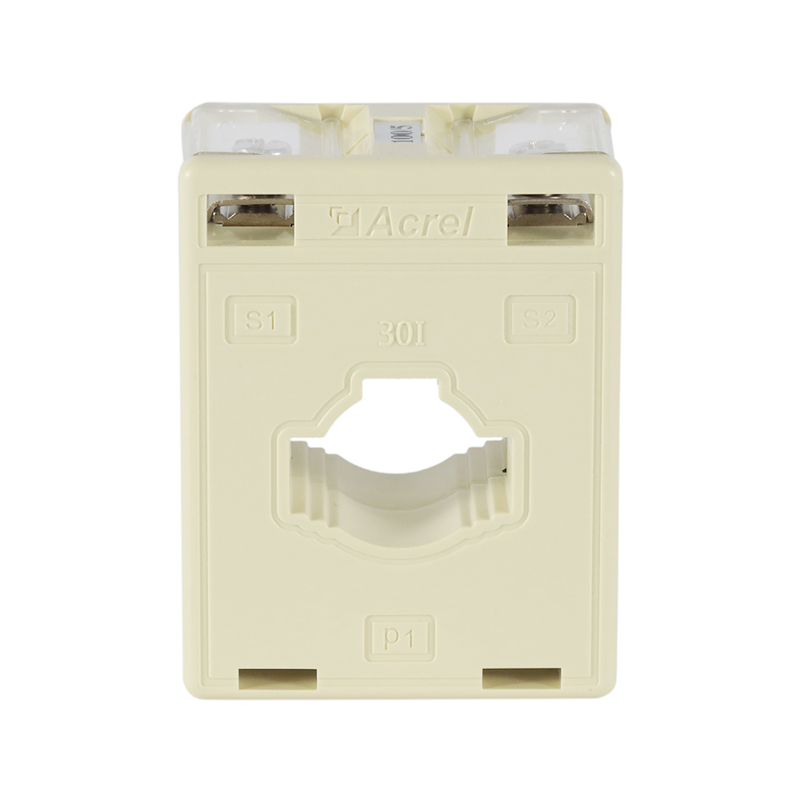 Acrel AKH-0.66/I Solid Core Current Transformer, 5A OutputThis solid-core CT suits new panels and OEM assemblies where conductors can be threaded before termination. Its 0.5 accuracy class and multiple window sizes make it a reliable pick for accurate metering in new construction.View Product →
Split-core CTs open around an existing cable without disconnecting the load. They are the standard choice for retrofit projects, energy audits, and temporary metering. When selecting a split-core CT, measure the outside diameter of the conductor, including insulation and any shielding, and then add 10-20% clearance. Acrel AKH-0.66 K series is one example of a hinged split-core design with a range of window sizes.
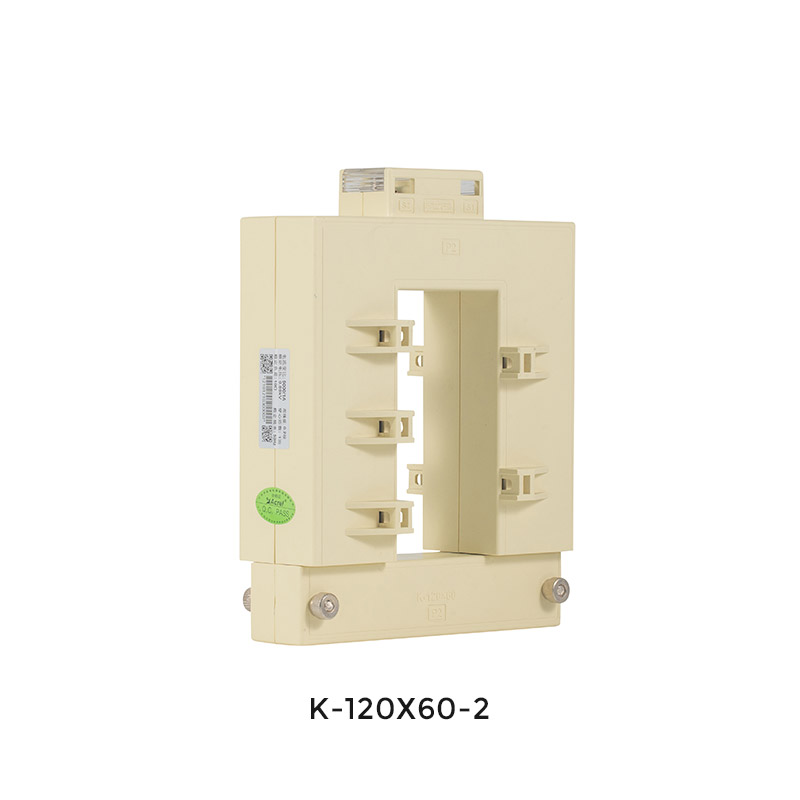 Acrel AKH-0.66/K Split Core Current Transformer for RetrofitsDesigned for power grid upgrades, this split-core CT mounts around existing busbars without disconnecting power. It is ideal for renovation projects, energy audits, and temporary metering while maintaining high accuracy.View Product →
For very large busbars, bundled conductors, or spaces where a rigid CT cannot be installed, a Rogowski coil is a flexible alternative. It is lightweight and can wrap around irregular shapes, but its output is a voltage proportional to the rate of change of current, so it requires a meter or integrator designed for that signal.
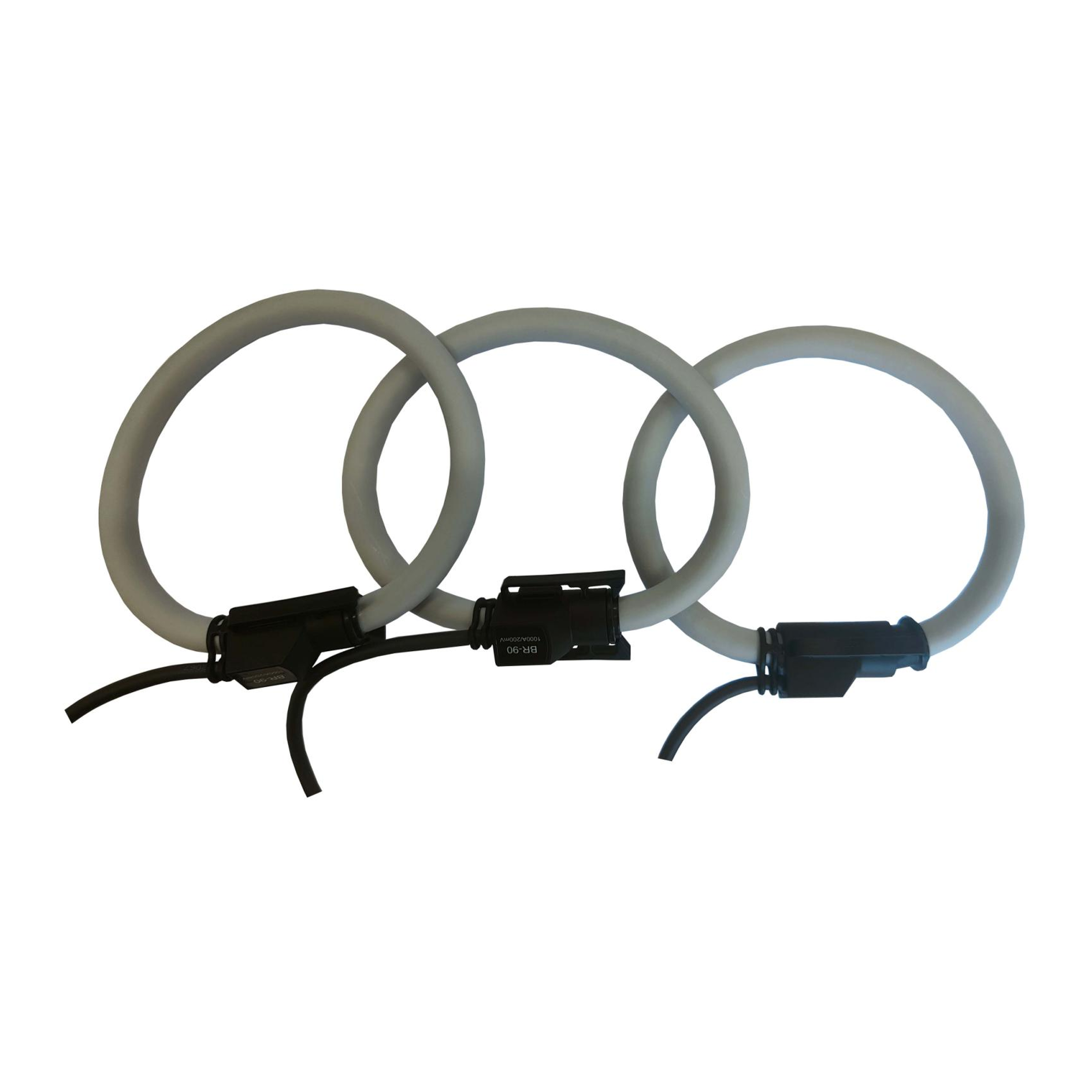 Acrel BR Series Flexible Rogowski Coil Current TransformerThis flexible coil wraps around large or irregular conductors without disconnection, rated up to 10,000A with high bandwidth and zero open-circuit hazards. Perfect for tight panels, energy audits, and harmonic monitoring.View Product →
| Core style | Best for | Installation | Considerations |
|---|---|---|---|
| Solid core | New panels, OEM equipment | Conductor must be open | High accuracy, compact |
| Split core | Existing cables, retrofits | Opens around cable | Check window clearance |
| Rogowski coil | Large busbars, irregular conductors | Flexible wrap | Needs integrator or compatible meter |
Window size is not negotiable: if the CT does not fit, the installation will require a busbar reposition. Measure the conductor or busbar plus insulation, and verify the CT window width and height, for example 30 mm x 20 mm or 120 mm x 40 mm. If you want to understand the magnetic construction behind these differences, our technical article on the internal construction and types of current transformers goes into the core and winding details.
Accuracy class is the percentage error allowed at rated primary current. For tenant billing or cost allocation, class 0.5 is usually the minimum practical choice; class 0.2 is better when the energy flow is large and the meter is calibrated to a similar level. For simple panel meters and building automation, class 1.0 is often acceptable. If the CT feeds a protection relay, choose a protection class such as 5P10 or 10P10, which guarantees the ratio error stays within limits up to the specified accuracy limit factor.
| Accuracy class | Typical application | Example CT configuration |
|---|---|---|
| 0.2 or 0.2s | Revenue metering, export/import billing | Solid-core CT with low phase error |
| 0.5 | Tenant sub-metering, energy management | Split-core or solid-core CT |
| 1.0 | Panel meters, trend monitoring | Compact AC CT, standard burden |
| 5P10 / 10P10 | Protection relay inputs | Protection-class CT with high saturation limit |
For buildings and industrial facilities that use this data in energy efficiency management, the CT accuracy directly affects how trustworthy the sub-metering results are. A high-accuracy CT is wasted if the meter itself has a lower accuracy class; match the complete chain from CT to meter to communication gateway.
For ordinary low-voltage switchgear and sub-metering, a CT with an insulation voltage of 0.66 kV or 0.72 kV is standard. Confirm that the CT is rated for the same system frequency, 50 or 60 Hz, and that the primary conductor size is within the CT rated continuous current and short-time thermal current.
Certifications matter when the CT will be used for utility billing, exported as part of a panel, or installed under a national wiring code. CE, UKCA, UL, and MID approvals are common marks; choose the one that matches the project location. A UL-recognized split-core CT, for example, simplifies approvals for panel builders selling into North America.
Finally, never operate a CT with an open secondary circuit while current is flowing in the primary. The secondary can reach dangerously high voltage and the core can saturate. Use shorting blocks or specify CTs with shorting terminals so maintenance can be done safely.
If you can state the load current, meter input, burden, core style, accuracy class, and target certification, you have already solved most of the CT selection problem.
Use the maximum continuous load plus a safety margin of about 20-50%. For a load that reaches 100 A, a 150 A primary is a sensible start. Then confirm the meter lower range so the CT is not oversized for the minimum load.
Yes, split-core CTs are widely used for retrofit sub-metering. Choose a class 0.5 or better version with a suitable window and burden, and use it with a meter of matching accuracy class.
Usually yes. A 1 A secondary produces much lower lead burden than 5 A on the same cable. If the distance is more than a few meters or the VA budget is tight, 1 A is the safer choice.
It depends on the destination. For European projects, CE and UKCA are often expected; for billing applications, MID may also be required. In North America, UL recognition is common for panel components. Confirm the project specification before ordering.


 Email: [email protected]
 Phone: +86-18702106858 / +86-21-69156352
No.253 Yulv Road, Jiading District, Shanghai, PRC 201801





