

 English
 Deutsch
News
Home / News / Industry News / How to Choose an Energy Meter: Key Specs, Accuracy, and Certifications
A facilities engineer at a mid-sized factory returned from a maintenance shutdown to a 14% jump in the monthly electricity bill. Six machines had been added to one production line, but no individual metering was installed on the six feeder circuits. The engineer had one aggregated reading and no way to separate lighting, compressors, and production equipment. That situation is exactly what a well-chosen energy meter prevents.
The short approach to how to choose an energy meter is to filter the catalog with five questions:
Answer these five in order, and the range of suitable models narrows quickly.
Start with the physical circuit, because the current type is a hard filter. A meter built for alternating current cannot measure a DC bus, and a DC meter on an AC feeder will not produce valid readings. Service entrances, distribution boards, HVAC panels, lighting circuits, motor feeders, and grid-fed equipment call for an AC energy meter. PV strings, battery storage banks, 48 V telecom distribution, DC fast chargers, and DC busbars inside data centers call for a DC energy meter.
Many sites are hybrids. A solar-plus-storage installation needs an AC meter on the grid side, sometimes a second AC meter for inverter zero-export control, and a DC meter on the storage side. Acrel separates AC and DC meters into distinct families: the ADL and DTSF series cover AC circuits, while the DJSF series and the MID-certified direct-input DC models cover the DC side.
One practical check before opening a datasheet: read the current type and voltage rating on the load nameplate. AC loads list a frequency such as 50 Hz or 60 Hz; DC loads do not. For the metering stage of a DC fast charger, the typical starting point is a direct-input DC meter with an MID certificate, because the meter participates in legally relevant charging revenue:
Accuracy class is the maximum percentage error a meter may show at defined calibration points. A Class 1.0 meter is allowed 1.0% error; a Class 0.5S meter stays within 0.5%. The S suffix is a low-load guarantee: the meter holds its accuracy at very small currents, which matters for equipment that idles in standby.
For internal energy monitoring, environmental reporting, and consumption benchmarking, Class 1.0 is normally sufficient. For tenant sub-billing, prepayment schemes, and EV charging revenue, the requirement usually rises to legal metrology: in practice, Class 1.0 or better with an MID approval. For data center PUE tracking, critical industrial processes, or tariff verification, choose Class 0.5S.
Quick accuracy guide: Class 1.0 for general monitoring and most sub-billing; Class 0.5S for critical circuits and PUE-grade data. The current transformer must be equal to or better than the meter class; otherwise the system accuracy follows the weaker component.
The meter is only half of the accuracy chain. Any CT-operated installation inherits the error of its transformers, so a 0.5S meter paired with a 1.0 CT is at best a 1.0 system. Buy the meter and CTs as a matched set.
A meter is only as accurate as the current transformers it is paired with. Specify the CT class at the same time as the meter class.
DIN rail meters snap onto a standard 35 mm rail inside a distribution board. They are compact, easy to replace, economical, and ideal for adding metering points to an existing board. Panel-mounted meters fasten into a cutout on the enclosure door, show more information on a larger screen, and offer more programmable parameters, so they are common on main switchboards and generator panels.
For most sub-metering projects - rented floors, factory zones, EV charger cabinets, retail branches - a DIN rail meter is the right default. Move to a panel-mounted meter when the reading must be visible through the cabinet door, when the specification calls for power-quality values, or when the meter is the centerpiece of the switchboard. The trade-offs between the two formats are examined in this guide to choosing between DIN rail and panel-mounted energy meters.
A typical sub-metering point on a single-phase board is served well by a direct-access DIN rail meter rated up to 100 A with RS485, because it clips onto the rail and reports straight back to the building management system:
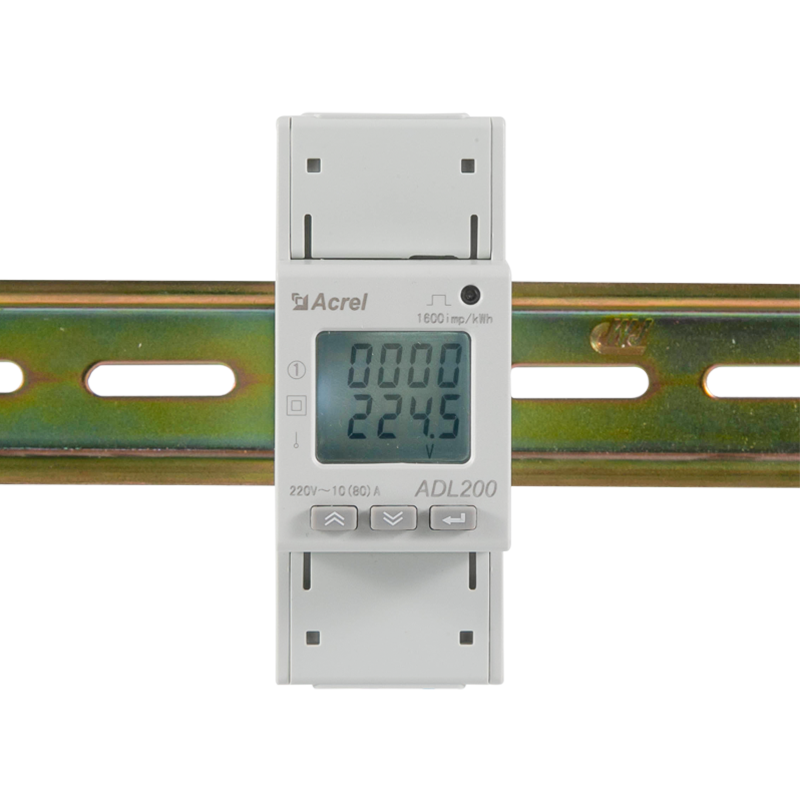 ADL200 Single-Phase DIN Rail Energy Meter with RS485 and ModbusThis compact single-phase meter measures active energy and key parameters, supporting RS485 Modbus-RTU for direct integration into building management systems. Its 80A direct input and Class 1 accuracy suit typical sub-metering points.View Product →
An energy meter with a display but no communication port is a manual-read instrument. It cannot reveal when a high-consumption machine runs outside scheduled hours, and it cannot feed a cost-allocation report. Choose the communication logic before the meter model.
RS485 with Modbus RTU remains the workhorse for wired installations: reliable, widely supported by building management systems, and easy to daisy-chain. Pulse output is a simple fallback for older controllers. For retrofit and distributed sites - telecom towers, rental apartments, remote shelters - cabling is often the most expensive part of the job, and a wireless IoT meter with Wi-Fi, LoRaWAN, or 4G cuts that cost.
The data path is part of the metering decision. Acrel normally pairs wireless meters with a smart gateway from the ANET or AWT100 series, which converts Modbus into Ethernet, Wi-Fi, 4G, or LoRaWAN and forwards data to a central platform. If the goal is a live dashboard, see how the IoT energy management solution is structured before finalizing the meter list.
When there is no communication wiring at all, a three-phase wireless IoT meter replaces a standard meter directly:
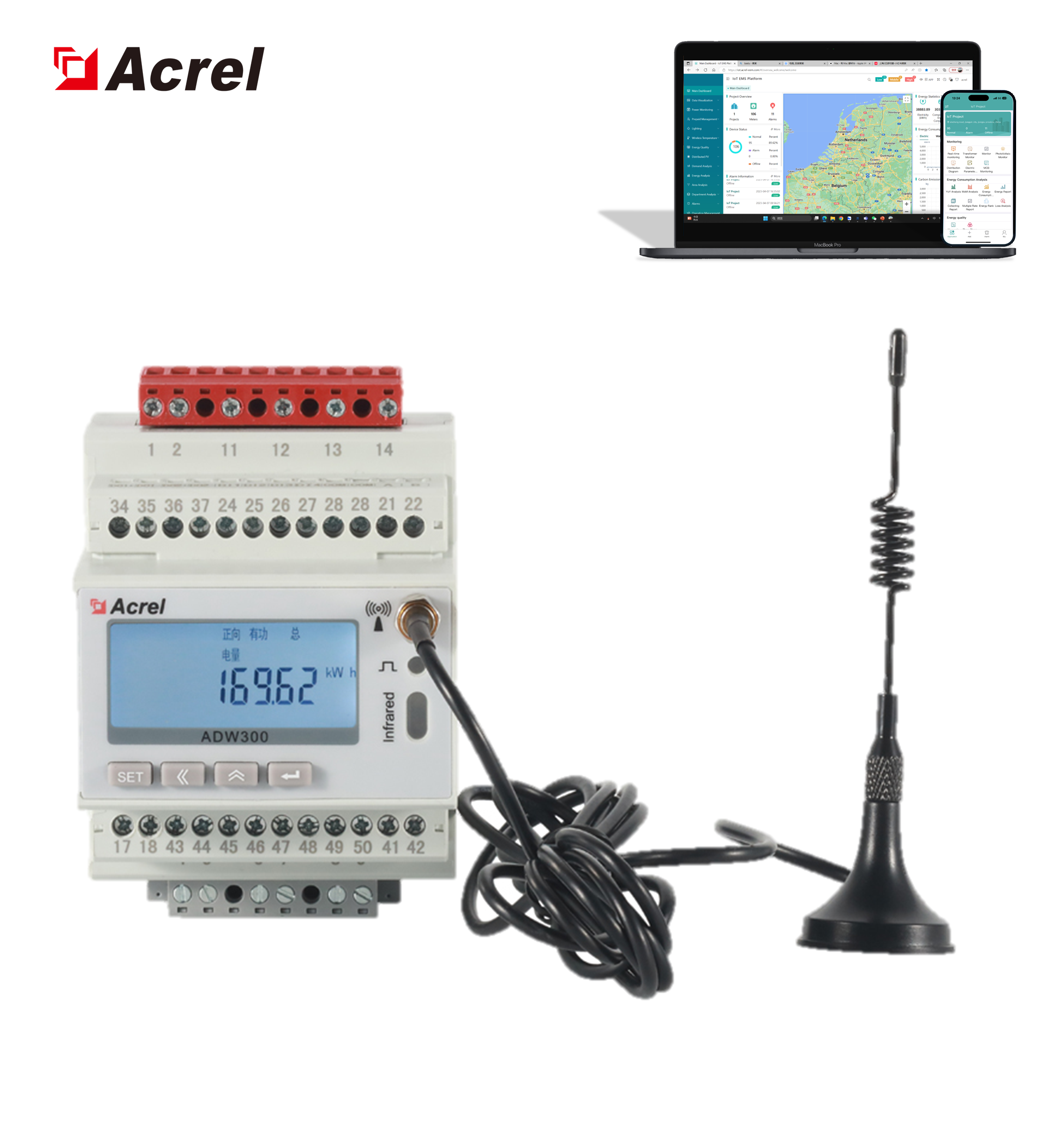 ADW300 Three-Phase Wireless IoT Energy Meter with Optional ConnectivityThis three-phase meter replaces standard units where no wiring exists, offering wireless options like 4G, Wi-Fi, LoRa, or LoRaWAN. It uses CTs for current sensing and supports Modbus or MQTT, ideal for remote monitoring in factories or schools.View Product →
Certifications are a legal gate, not a marketing badge. In the European Union, a meter used as the basis of a bill must carry an MID certificate. In the United States and Canada, a UL or cUL listing is expected for permanently wired equipment. CE covers electromagnetic compatibility and electrical safety, but CE is not a measuring-instrument approval.
Concrete case: a European property owner meters each office unit and uses the readings for monthly rent settlement. Each meter must be MID certified and sealed because the readings determine a price. A meter with identical features but only an EMC report is not an acceptable alternative.
CE is not a legal metering approval. If the reading determines a price, check that the meter carries the measuring-instrument certificate required in the country of installation.
Ask for the certificate scope, not just the logo. Relevant references are EN 50470-3 for AC meters under the Measuring Instruments Directive, EN 62053 for industrial meters, IEC 61000-4-xx for EMC, EN 61010 for safety, and IEC 61557-8 for insulation monitoring. Acrel publishes EMC, LVD, RED, MID, and UL reports for each series, which makes this check fast.
The table below condenses the five decisions into one checklist you can use when comparing quotations:
| Decision | Question to Ask | Common Choice | Pitfall to Avoid |
|---|---|---|---|
| Circuit type | Is the load fed by AC or DC? | AC for mains-fed loads; DC for PV, storage, EV, telecom | Installing an AC meter on a DC circuit |
| Accuracy class | Is the value used for billing or monitoring? | Class 1.0 for monitoring; Class 0.5S for critical loads | Ignoring the current transformer class |
| Mounting | DIN rail or panel door? | DIN rail for sub-metering; panel for main switchboards | Choosing a format that is hard to read or retrofit |
| Communication | RS485, pulse, or wireless? | RS485 for new wiring; wireless for retrofit | No plan for connecting meters to software |
| Certification | MID, UL, CE, or UKCA? | MID for EU billing; UL for North America | Assuming CE is enough for billing |
The class number is the maximum percentage error allowed at calibration test points. Class 1.0 allows 1.0%; Class 0.5S allows 0.5%. The S suffix means the meter keeps its accuracy at very low currents. Use Class 1.0 for ordinary monitoring and sub-billing, and Class 0.5S for critical loads.
Direct-connection meters pass the full load current through the meter, usually up to 60 A to 125 A in common AC models and up to 600 A in some DC designs. Above that range, or when the circuit is already served by busbars with CTs, choose a CT-operated meter with a 1 A or 5 A secondary input.
In most EU countries, yes, if the measurement is the basis of a charge. The meter must meet the accuracy, durability, and EMC requirements of the Measuring Instruments Directive. For internal reporting only, an MID certificate is not mandatory, but it keeps the option open.
If the building has no communication cabling, a wireless IoT meter with Wi-Fi or LoRaWAN is usually the fastest route. If new wiring is possible, RS485 Modbus remains the most robust and economical choice. For sites without a local network, a 4G gateway provides central cloud access.
The right energy meter survives contact with the installation: correct current type, realistic accuracy, suitable format, working communication, and lawful certification. When the five questions line up, the meter stops being a compliance object and starts being a management instrument.
For projects with several circuits or buildings, plan the whole chain - meter, CTs, gateway, platform - as one system. That is the approach across Acrel's deployed projects, from data center precision monitoring to telecom tower tracking, and it is the fastest way to turn unexplained bills into actionable decisions.


 Email: [email protected]
 Phone: +86-18702106858 / +86-21-69156352
No.253 Yulv Road, Jiading District, Shanghai, PRC 201801





