950 Current Monitoring Points on Polycarbonate Extrusion Lines
A leading Italian polycarbonate manufacturer — from field transducers to a central EMS platform.
Customer: A leading Italian polycarbonate manufacturer (Turin, Italy) Industry: Polycarbonate sheet extrusion Points: 950 measurement channels Live: Q4 2026
Industry Background
The plastics extrusion sector is among the most energy-intensive in manufacturing. In Europe, industrial electricity prices have remained elevated since the 2022 energy crisis, while the Corporate Sustainability Reporting Directive (CSRD), the EU Energy Efficiency Directive, and Italy's National Recovery and Resilience Plan (NRRP) are pushing manufacturers to digitize energy consumption per equipment.
For polycarbonate sheet extrusion specifically:
Main extruder screw motors run continuously at 30–90 kW, driven by voltage inverters.
Each line has 3–5 barrel heating zones controlled by SCR/PID power controllers.
Inverters and SCR controllers produce non-linear, distorted current waveforms that defeat conventional average-reading meters.
To control cost, comply with ESG data requests from automotive and building clients, and detect equipment faults early, extrusion plants need per-equipment current and energy visibility — not just a single main-meter reading.
Project Overview
A leading Italian polycarbonate manufacturer, founded in 1960 and headquartered near Turin, is a world-class producer of polycarbonate sheets and building daylighting systems. It operates production sites in Italy, Germany, Greece, Turkey, India, and the USA, supplying automotive, industrial, and construction customers worldwide.
The project covers equipment-level current monitoring across the extrusion workshop at the Italian headquarters plant. The customer already operates a trigeneration plant, rooftop photovoltaic array, and closed-loop water system; this project adds the production-side granularity needed to close the energy loop.
Project at a glance
Item
Model
Qty
Role in the plant
AC current transducer, True RMS, φ20 bore, 40–200A, 4–20mA
Non-linear loads defeat ordinary meters. Inverters and SCR heater controllers produce distorted current. Average-reading transducers were off by 10–20%, so energy data could not be trusted for cost accounting or ESG reports.
No per-equipment visibility. Only the main incoming feeder was metered. Plant management could not tell which line, which heater zone, or which auxiliary was consuming what — making waste hunting and cost allocation impossible.
Reactive maintenance only. Degrading heater bands, motor imbalance, and bearing wear were discovered only after product quality slipped. The plant had no current-trend data to predict failures.
ESG / CSRD data demands. As a Tier supplier to automotive OEMs and major construction projects, the customer needs auditable, per-product energy data for sustainability disclosure.
High cost of 950 standalone meters. Putting a panel meter on every one of 950 points would be expensive and would demand enormous cabinet space and wiring labor. A distributed, modular architecture was required.
Integration with existing infrastructure. The plant already runs a DCS and a trigeneration / PV monitoring system. New hardware had to speak standard Modbus-RTU and fit existing DIN rails, not force a rip-and-replace.
Acrel Solution — A 4-Layer Architecture
Acrel proposed a layered, bus-based system: sensing at the equipment → modular acquisition in the cabinet → main feeder metering → central EMS platform. Every layer uses standard Modbus-RTU so it plugs into the customer's existing infrastructure.
LAYER 1 — FIELD SENSING
BA Series AC Current Transducers
BA20-AI/-T (×300) on main extruder motor feeds and large auxiliary circuits. The -T suffix means True RMS, accurately reading the distorted current from VFD-driven motors and SCR heaters — solving the 10–20% measurement error directly. φ20mm bore, AC 40–200A range, DC 4–20mA isolated output, DC24V supply, 0.5 class.
BA10-AI (×650) on barrel heating zones, vacuum feeders, pelletizers, cooling pumps and branch circuits. φ10mm bore, AC 8–50A range, same 4–20mA output. Both mount on standard DIN35 rail, keeping retrofit labor minimal.
LAYER 2 — DATA ACQUISITION
ARTU100 Remote Terminal Units
BA transducers' 4–20mA signals are wired into ARTU100-MA84 analog input modules (8 AI channels each, configurable 0–20mA / 4–20mA / 0–5V / 1–5V), so dozens of sensors share one compact DIN-rail unit instead of one meter per point.
ARTU100-KJ8 / KJC8 collect the on/off status of main contactors and heater circuits (8DI + 8DO), enabling remote monitoring and alarm trips. Dual isolated RS485 ports run Modbus-RTU; an optional CE Ethernet module or AWT100-4G gateway links the cabinet to the plant server.
LAYER 3 — FEEDER METERING
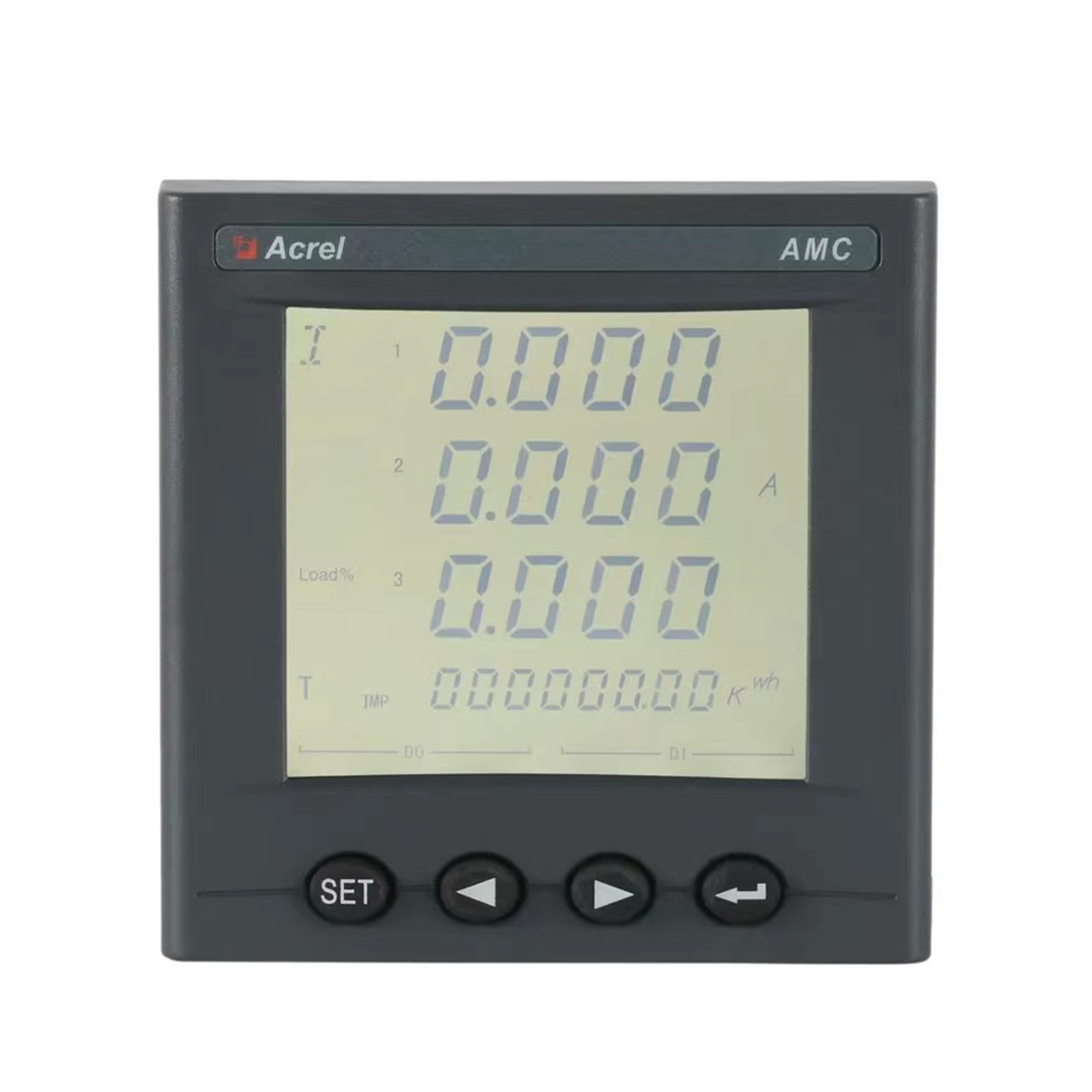
AMC96L-E4/KC Multifunction Panel Meters
Installed on each workshop main feeder and each extrusion line distribution panel. The AMC96L-E4/KC measures three-phase V, I, active/reactive/apparent power, power factor, frequency, and four-quadrant kWh; the optional harmonic option reads the 2nd–31st harmonics caused by inverters.
RS485 / Modbus-RTU (and DLT645), optional 4–20mA analog output to the existing DCS. It replaces legacy analog panel instruments and standalone transmitters with a single digital device.
LAYER 4 — CENTRAL PLATFORM
Acrel-EMS Energy Management System
All ARTU100 units and AMC meters converge via RS485 fieldbus → AWT100 gateway → Acrel-EMS server. Deployed functions:
Real-time single-line diagram with per-line current, voltage, power, and energy dashboards.
Per-extruder and per-heater-zone energy statistics, with cost allocation by line, shift, and product batch.
Threshold alarms: over-current, under-current on heater circuits (element breakage), and long-running idle equipment.
Historical trending and exportable ESG / CSRD-compliant energy reports.
Native integration view with the plant's existing trigeneration and rooftop PV data, so the whole-site energy balance is visible on one screen.
Project Benefits
Dimension
Outcome for the Customer
Measurement trust
True-RMS BA20 transducers eliminate the 10–20% error on inverter/SCR loads. Energy data is now accurate enough for cost accounting and customer-facing ESG reports.
Granular visibility
950 points cover every extrusion line, every heating zone, and every auxiliary — the workshop is no longer an energy "black box."
Predictive maintenance
Under-current alarms flag degraded heater bands and motor load deviations before product quality drifts, cutting unplanned downtime on expensive extrusion lines.
Lower cost per point
Modular ARTU100 acquisition (8 AI per module) instead of 950 standalone panel meters slashes hardware cost, cabinet space, and wiring labor.
ESG & customer compliance
Automated per-product energy data feeds CSRD reports and answers automotive / construction customer questionnaires without manual meter readings.
Scalability across the group
Same Modbus-based architecture can be replicated to the customer's plants in Germany, Greece, Turkey, India, and the USA — one standard, one supplier.
Energy savings direction
With per-line and per-zone data, plants typically identify 5–10% reduction opportunities (idle equipment, inter-line imbalance, standby losses).
Running a plastics, extrusion, or similar energy-intensive plant?
Acrel delivers end-to-end: current transducers → RTU acquisition → panel meters → EMS platform. Get a tailored proposal for your workshop.


 English
 Deutsch
 Part 1: Introduction 1.1 What is Power Quality and Why is it Important? In modern society, a stable ...View More
 Introduction to AC Energy Meters In today’s rapidly evolving energy sector, accurate measurement and...View More
 I. Introduction: The Critical Need for Motor Protection Electric motors are the undisputed workhorse...View More
 Introduction In modern industrial and commercial power environments, precise measurement and managem...View More


 Email: [email protected]
 Phone: +86-18702106858 / +86-21-69156352


