

 English
 Deutsch
No.253 Yulv Road, Jiading District, Shanghai, PRC 201801
Energy Monitoring for Distributed Battery-Swapping Stations
Home / Projects / Commercial Buildings / Energy Monitoring for Distributed Battery-Swapping Stations
Title tag: Energy Monitoring for 50+ Battery-Swapping Stations in Uganda | Acrel Case Study
Meta description: How Acrel metered a distributed e-motorcycle battery-swapping network in Uganda: one 4G-connected ADW300 meter on each station's incoming feeder, NTC temperature monitoring on cable lugs, and a single IoT EMS platform for the whole network.
H1: Metering 50+ distributed battery-swapping stations without a single site visit
Standfirst: One 4G-connected ADW300 meter in each street cabinet turns every swap station into a metered, alarm-aware node of a single cloud platform — from Kampala to the last district on the network.
Client: GOGO, e-mobility operator | Location: Uganda | Scope: station metering plus cloud platform | Status: live, scaling
Key figures strip
2 An electric business whose electricity was invisible
GOGO runs electric motorcycles in Uganda and keeps them on the road with a network of battery-swapping cabinets. A rider arrives with a depleted pack, swaps it for a charged one and leaves in under two minutes. Commercially, the whole model rests on electricity — but per site, nobody could see how much was consumed, when the peak fell, or whether a cabinet was quietly drawing current at three in the morning.
The network made that harder than usual. Stations sit in different districts, in street-side enclosures with a few hundred millimetres of spare rail space, fed by grids whose quality and availability vary from block to block. Battery charging is also the least forgiving load in the building: a loose lug or a corroded joint does not fail gracefully.
What the operator needed was not a report generator. It was an instrumentation layer that could be dropped into a cabinet in an afternoon, survive patchy connectivity, and still hand headquarters one comparable number per site.
What the network required
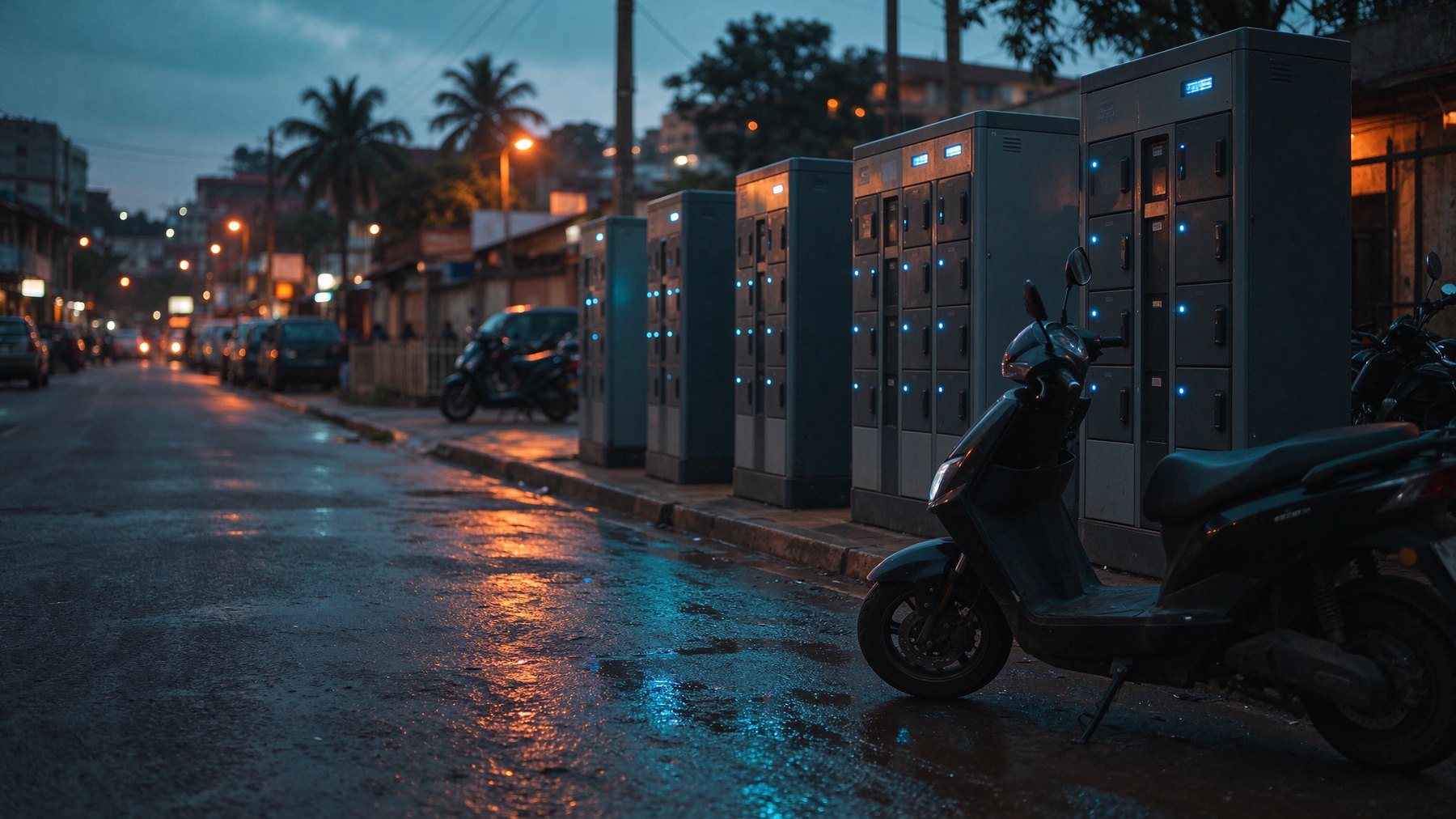
Figure 1. A swap point at the end of the working day. Compact, street-side cabinets, fed from whatever the local grid provides — the three constraints that shaped the metering design.
3 The design: one meter on the feeder, one cloud — nothing in between
The system is deliberately shallow. Each cabinet gets a single ADW300 four-quadrant meter on its incoming feeder, downstream of the main breaker, with three split-core current transformers clamped onto the existing cable and two NTC probes wired into the meter's temperature channel. Nothing is re-terminated, so the retrofit does not interrupt service beyond the time it takes to open the cabinet.
From there the chain is one hop. The meter carries its own 4G module and SIM and pushes frames straight to the Acrel IoT EMS platform. There is no gateway to power, no spare rail to find, and no second device that can fail on its own. When coverage drops, the meter keeps integrating: energy registers continue to accumulate, so an outage shows up as a gap in real-time data that reconciles on reconnect, not as missing kWh in the settlement.
Figure 2. System topology. The meter takes its measurements at the feeder and its uplink from its own 4G module; the NTC probes wired into its temperature channel watch the cable lug and the busbar joint.
Why the meter sits on the incoming feeder rather than on the chargers
Why there is no gateway on site
4 What goes into each cabinet
Quantities are per station; the bill of material is identical across the network so that a spare kit can be carried on a service run instead of ordered per site.
Table 1. Bill of material per swapping station (typical configuration)
|
Item |
Model |
Qty |
Role in the system |
|
IoT energy meter |
ADW300-4G / ADW300W |
1 |
Station-level kWh, demand and harmonics at class 0.5S; 2 DO / 4 DI; NTC input; integrated 4G uplink |
|
Current transformer |
AKH-0.66/K split-core |
3 |
Clamped onto the incoming cable; ratio selected to the feeder rating so the meter reads full-scale load |
|
Temperature probe |
NTC, 2 m lead |
2 |
Incoming cable lug and busbar joint; wired straight into the meter's temperature channel |
|
4G SIM and data plan |
Operator or Acrel APN |
1 |
Roughly 15 MB per meter per month at a five-minute reporting interval |
|
Platform tenant |
Acrel IoT EMS |
1 |
Multi-site supervision, role-based access, alarms, history and API for settlement |
Figure 3. ADW300: DIN-rail meter with split-core CT input, 2 DO / 4 DI, an NTC channel and the 4G module behind the antenna lead. One device per cabinet, no companion gateway.
Figure 4. The retrofit in place: ADW300 on the DIN rail, three split-core CTs clamped on the incoming cable, no re-termination and no additional panel.
5 Station level or charger level? Where to put the boundary
This is the decision that determines what the data can be used for later. Metering the incoming feeder answers “how much energy did this site consume”; metering each charger bay answers “who consumed it”. Most networks start with the first and add the second only where money changes hands at the bay.
Configuration A — one meter on the incoming feeder (deployed here)
Configuration B — branch meters on each charger bay (next step)
Rule of thumb: if the operator sells kilometres or unlimited packs, station-level metering is enough. If the operator sells kWh, meter at the bay as well — and keep the station total as the reconciliation reference that keeps both sets of numbers honest.
6 What changed on the operator's side
Figures below cover the first six months of operation and are reported per site and per portfolio.
Maintenance — first-line diagnosis moved to the platform
Routine inspection visits fell from two per site per month to one. A technician now travels only when the data says a part is actually needed, which matters when the sites are hours apart.
Safety — temperature alarms before failure, not after
23 joint-temperature alarms were raised in the first six months, each traced to a specific probe on a specific lug, so the response was a torque wrench rather than a fire extinguisher.
Energy — a baseline that did not exist before
Every station now has a normal range for its consumption and demand. Off-pattern sites are flagged within 24 hours instead of being found at the next invoice.
Commissioning — a new station is live in under half an hour
Bind the meter to the tenant, assign it to a region, apply the alarm rules: 25 minutes per site, no site visit for configuration. That is what makes 50 stations a year an operational routine rather than a project.
Commercial — data that can be settled against
Metered consumption feeds the operator's own systems through the platform API, so per-kWh pricing and rider billing are reconciled against the same device that measured them.
Resilience — coverage, not a construction project
Where a district's 4G is thin, the meter simply stores frames until the link returns. Nothing on site changes, no gateway is trucked out, and the totals reconcile when the site reconnects.
Figure 5. The operator's own tenant in Acrel IoT EMS: project groups and meters on the map, device health split into normal, offline and alarmed, today's energy and carbon figures, and an alarm list naming the circuit and the event.
7 Why the same layout travels
The Ugandan network is not a special case, and the design does not depend on it. Distributed swap networks in Kenya, Rwanda, Nigeria and Southeast Asia face the same four conditions: many small sites, uncertain connectivity, no room for equipment, and a thermal risk that sits next to a customer.
The same meter family covers the adjacent use cases an operator usually meets next: EV charging hubs where bay-level billing is required, telecom tower sites where a multi-circuit meter replaces a row of single meters, and commercial buildings where the incoming feeder is metered before sub-distribution.
Where a market requires regulated billing, MID and UL variants of the same platform are available, and the platform can run on Acrel's cloud or on the operator's own server when data residency is a condition of the contract.
How a station gets commissioned
Figure 6. Battery cabinets are the least forgiving load on the site: continuous charging, high current at the joints, and a customer standing next to it.
8 Questions operators ask about the same network
Q1 Does one meter really cover a whole swap station?
For station-level accounting, yes. The ADW300 measures the incoming feeder, so it captures chargers, battery racks, lighting and air conditioning in one figure. If you need to bill riders per kWh or benchmark individual chargers, add branch meters on the charger feeders and keep the incoming meter as the reconciliation total.
Q2 What happens when a site has no reliable internet?
Buffering lives in the meter rather than in a gateway. Energy registers keep integrating while the link is down, frames are retried with a timestamp, and the platform reconciles the cumulative readings when the site reconnects. A late frame is never mistaken for zero consumption.
Q3 Is a 4G SIM per meter expensive to run?
At a five-minute reporting interval a meter moves roughly 15 MB a month. If the operator prefers, the SIMs can sit on a private APN with a fixed IP pool, or on a local carrier plan — the meter only needs an outbound MQTT connection.
Q4 Can it be retrofitted without shutting the station down?
In most cabinets the work is done on a planned outage of a few minutes: open the cabinet, clamp the split-core CTs onto the existing feeder cable, land the NTC probes, commission the meter. No cable is cut and no new panel is added, which is what keeps a 50-site rollout practical.
Q5 How is overheating actually detected?
Two NTC probes per cabinet feed the meter's temperature channel: one on the incoming cable lug, one on the busbar joint — the points that heat first when a connection loosens. Each channel has its own threshold, and the alarm names the site and the channel rather than just reporting high temperature.
Q6 Can the data go into our billing or rider app?
Yes. The platform exposes Modbus-TCP and MQTT for SCADA-style integration and an HTTP API for application use. In this project the metered kWh feeds the operator's own settlement, so a rider's session and the site total are traceable to the same device.
Q7 Cloud or on-premise, and what about certification?
Either. Acrel IoT EMS runs as a hosted service or on a server inside the operator's own network when data residency is required. The meter family is CE and IEC compliant, and MID or UL variants are available where a market requires them for billing.
9 Closing call to action
Headline: Planning a swap network and need a metering layer that survives it?
Body: Send us the feeder rating, the cabinet photo and the 4G coverage you have at each site. We will come back with a configuration, a bill of material and a commissioning sequence — not a catalogue.
Buttons: Download the ADW300 datasheet / Book a 20-minute technical call

 Email: [email protected]
 Phone: +86-18702106858 / +86-21-69156352
No.253 Yulv Road, Jiading District, Shanghai, PRC 201801





