

 English
 Deutsch
News
Home / News / Industry News / Electrical Equipment Overheating Warning: Acrel Wireless Temperature Monitoring Solution
With the continuous development of the global economy and industrial technology, electrical power systems play an increasingly important role in modern society. The safety and reliability of power system operation have therefore become critical concerns for the industry. In particular, with the widespread deployment of unmanned substations, traditional manual inspection methods are gradually being replaced by intelligent monitoring technologies.
Wireless temperature monitoring technology provides real-time temperature detection for key heating points of high-voltage electrical equipment. By collecting and analyzing temperature data continuously, this technology helps ensure safe and stable operation of power systems while supporting predictive maintenance strategies.
In power plants and substations, long-term operation of high-voltage switchgear, outdoor disconnect switches, and busbar connection points may lead to local overheating. This is mainly caused by increased contact resistance, oxidation, dust accumulation, or mechanical loosening.
Since high-voltage equipment terminals are usually exposed to high electric fields, traditional contact-based temperature measurement methods cannot be safely applied due to insulation risks.
Wireless temperature monitoring technology solves this problem by transmitting temperature data via radio signals. The temperature sensors are directly installed at heating points, while the monitoring device remains electrically isolated from high-voltage equipment.
Compared with traditional measurement methods, wireless temperature monitoring systems offer several advantages:
1. High Safety
There is no direct electrical connection between sensors and monitoring systems, which reduces electrical hazard risks.
2. Real-Time Monitoring Capability
The system enables continuous temperature data acquisition and remote monitoring.
3. Low Maintenance Cost
Wireless monitoring replaces frequent manual inspection, reducing labor costs.
4. Data Storage and Analysis Support
Temperature data can be stored in central control systems for long-term analysis and predictive maintenance decisions.
Currently, commonly used temperature monitoring technologies include fiber optic temperature measurement, thermistor measurement, infrared temperature measurement, and wireless temperature measurement. Among these technologies:
The wireless temperature monitoring system is mainly used for monitoring temperature changes in high-voltage and low-voltage switch cabinets, cable joints, circuit breaker contacts, busbar joints, and transformer equipment.
The system detects potential safety risks caused by factors such as oxidation, loosening, or dust accumulation that may increase contact resistance during operation.
The core functions of the system include:
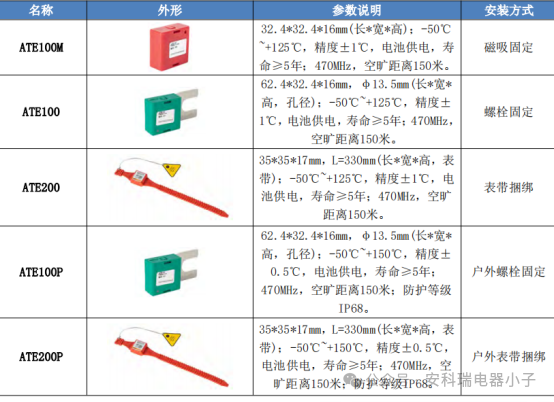
These sensors are installed directly at equipment heating points. They are powered by built-in batteries and transmit data wirelessly. They are suitable for high-voltage switchgear contacts and busbar joints.
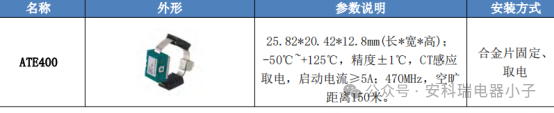
These sensors are mainly used in high-current operating environments such as circuit breaker contacts, busbar connection points, and high-voltage cable terminals. The sensors obtain power through current transformer induction, eliminating the need for battery replacement and extending service life.
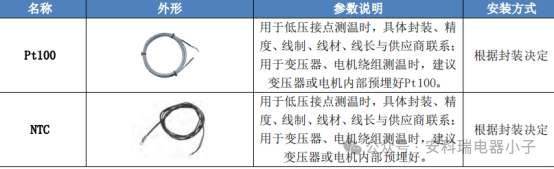
Wired sensors are mainly used in low-voltage equipment or high-precision monitoring scenarios, such as transformer windings and motor windings. Pt100 resistance temperature detectors are commonly used as sensing elements.
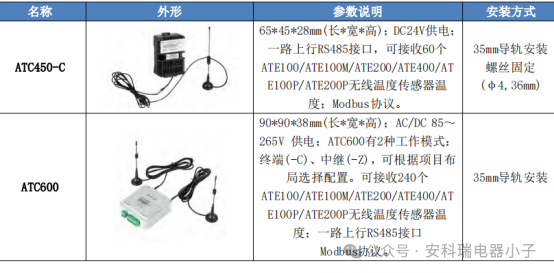
Wireless temperature monitoring systems typically consist of receiving modules and display terminals.
Receiving Unit
Responsible for receiving and processing temperature data transmitted from sensors.
Display Unit
Used to visually display temperature curves, equipment status, and alarm information.
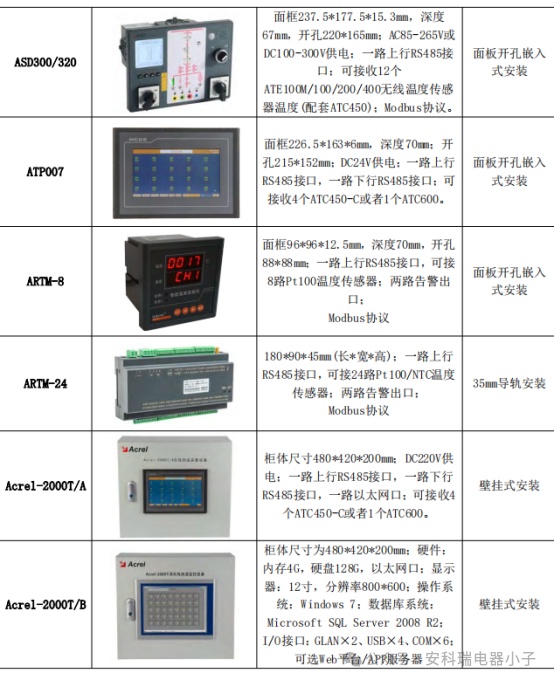
This structure allows maintenance personnel to monitor equipment operation status in real time.
The Acrel-2000/T wireless temperature monitoring system integrates temperature data from all monitoring devices in the substation into a centralized management platform.
The system combines computer technology, communication technology, and data processing technology to achieve centralized monitoring and management of temperature information.
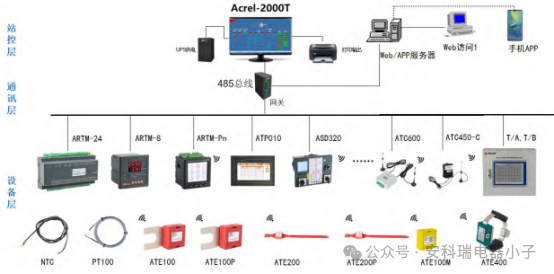
Main functions include:
The system is equipped with an independent database for long-term data storage and equipment operation analysis. By analyzing temperature trends, engineers can evaluate equipment aging conditions and optimize maintenance decisions.
Wireless temperature monitoring technology is widely used in multiple industries, including:
Common monitoring locations include:
The system helps improve equipment operation reliability through real-time monitoring and early warning functions.
The application of wireless temperature monitoring technology significantly improves power system operation management.
Key benefits include:
Traditional scheduled maintenance is gradually evolving into condition-based maintenance supported by intelligent monitoring technologies.
Wireless temperature monitoring technology plays an important role in ensuring safe operation of electrical power systems. By continuously monitoring and analyzing temperature data, it is possible to predict equipment degradation and prevent potential failures.
With the development of Internet of Things (IoT) technology and smart grid construction, wireless temperature monitoring technology will play an increasingly important role in future power system safety management.


 Email: [email protected]
 Phone: +86-18702106858 / +86-21-69156352
No.253 Yulv Road, Jiading District, Shanghai, PRC 201801





